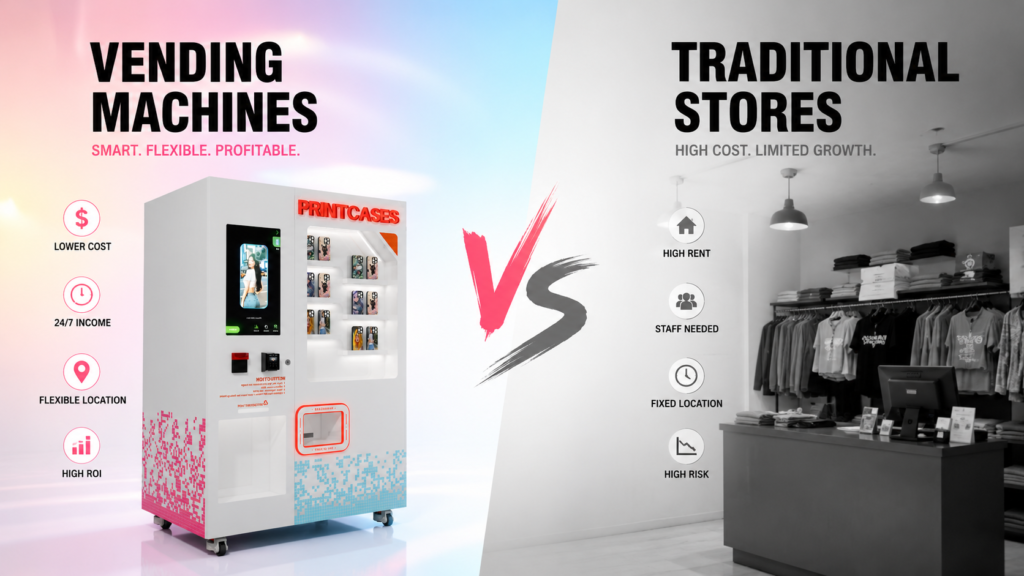
Vending machine vs traditional store is a key question for new operators who want to start retail with lower fixed pressure.
A traditional store is a familiar concept. However, it typically entails expenses related to rent, staff, fixtures and fittings, utilities (water, electricity, gas), inventory, insurance, licenses, and day-to-day management.
A vending machine operates differently. Retailers can start with a single machine, one product type, and a trial location. If the location proves unsatisfactory, the machine can be moved later.
1.Traditional stores have higher fixed costs
Before opening a store, retailers must consider far more than just the cost of the product.
The U.S. Small Business Administration (SBA) notes that startup costs can include space, equipment, utilities (water, electricity, gas), licenses, permits, insurance, inventory, employee wages, marketing, and monthly expenses.
Source:
https://www.sba.gov/business-guide/plan-your-business/calculate-your-startup-costs
This is significant because a store is tied to a fixed location. Once the lease is signed, the space fitted out, and staff hired, changing course becomes more difficult.
A vending machine also requires an investment (machine cost, product inventory, shipping, installation, maintenance, and restocking)—something a traditional retail store does not require.
2.Labor costs change the calculations
Labor cost is one of the key differences between a vending machine and a store.
According to O*NET Online, which uses wage data from the Bureau of Labor Statistics, retail workers earned a median hourly wage of $17.03 in 2025. Cashiers earned $15.81 per hour.
Sources:
https://www.onetonline.org/link/summary/41-2031.00
https://www.onetonline.org/link/summary/41-2011.00
Estimated monthly wage costs:
Sales associate: approximately $2,950 per month
Cashier: approximately $2,738 per month
Total: approximately $5,688 per month
This figure does not include payroll taxes, social security contributions, overtime, training, or administrative time. Furthermore, an automated kiosk does not require a cashier to be present at all times. Operators still need to handle restocking and basic maintenance, but the number of employees is significantly reduced.
3.ROI Example: NOVA mobile phone case printing kiosk
Let’s take the NOVA mobile phone case printing kiosk as an example.
For each custom case:
Product cost: approximately $2
Selling price: over $20
Gross profit: over $18
Gross margin: approximately 90%
This model is attractive because it allows operators to focus on a single product category, a small footprint, a pilot retail location, and a clear profitability model.
A traditional store must first cover rent, staffing, fixtures, and daily operating costs. In contrast, a mobile phone case kiosk reduces labor costs and simplifies the business model.
4.Break-even point: how many sales cover labor costs?
The SBA (Small Business Administration) explains the break-even point using the following formula:
Fixed costs ÷ (Price – Variable costs) = Units needed to reach the break-even point
Source:
In the example of NOVA mobile phone cases, each sale generates a gross profit of approximately $18.
To cover the cost of one salesperson:
$2,950 ÷ $18 = approximately 164 sales per month
To cover the cost of a salesperson and a cashier:
$5,688 ÷ $18 = approximately 316 sales per month
This means a traditional store might need around 316 sales of custom mobile phone cases per month just to cover the base salaries of two employees. And that is without counting rent, utilities, insurance, marketing, and inventory losses.
5. Vending machines are easier to test
A store is fixed. If the location performs poorly, operators cannot simply move the shop overnight.
A vending machine gives operators more flexibility. They can test one location first, review sales data, adjust the product strategy, and move the machine if needed.
This is important for beginners. The first goal is not to build a large retail shop. The first goal is to prove demand with lower fixed pressure.
Final Answer: Which Model Fits New Operators Better?
A traditional store may fit operators who need a full retail space, face-to-face service, and a large product display.
However, a vending machine is often easier for beginners to test. It needs less space, less labor, and lower fixed daily pressure.
So, what is your first test location?
A mall, campus, station, hotel, gym, office building, or tourist area may all fit different vending machine models.
NOVA helps B2B operators choose vending machines based on product type, location, budget, and shipping needs.
Explore NOVA vending machine solutions:
https://novavending.ai/products/
Get your personalized quote with shipping:
https://novavending.ai/quote/